
Mar 28, 2023 | Tools
Projects often start with positive intentions, especially if you hold a good kick-off workshop which generates lots of ideas and action plans, and the team leave the event feeling energised and hopeful. Pretty soon, however, the reality of delivery kicks in and all the plans that would have embedded collaborative ways of working drift to the periphery of the agenda. So how do you keep the momentum going after the initial workshop is over? The best mechanism we have found is to establish a collaboration workstream.
A workstream is essentially a cluster of tasks that need to be completed to achieve a particular outcome within the project. The point of the collaboration workstream is to follow up on the actions and initiatives that the leadership team know are important, but are often otherwise displaced by the urgent issues that typically dominate their agenda. To give an example, the following list of questions emerged from the output of a recent project kick-off workshop:
- How do we establish a culture of ‘collaborative delivery’ throughout the project so that everyone understands the positive behaviours?
- What are the teams’ non-financial objectives and what are activities that will support their achievement?
- What actions are needed to develop a well-considered Relationship Management Plan?
- How does the project leadership monitor and measure the relationships between the key parties involved?
- How do we establish a communication strategy that emphasises the underlying narratives that will support a collaborative culture?
- What is the collaborative maturity of the teams and what training is needed to improve their collaborative skills?
- Where are the potential areas of disagreement/dispute that potentially lie ahead and how do we prepare the teams to avoid or resolve them?
- How do we define collaborative ways of working and how do we communicate them to everyone working on the project?
Each of these questions is a component of the overall delivery strategy that will require different levels of attention throughout the project lifecycle. As you can see, there is a lot to do, and so the tasks that arise from the discussion need to be resourced, organised and managed. It, therefore, makes sense to form a ‘Collaboration Workstream Steering Group’ that meets at regular intervals to oversee the progress. We recommend that the membership of the group should be no more than 5 to 6 people. Within this group, there must be a senior project manager or leader and ideally a collaborative specialist. The remainder of the group should be selected from individuals senior enough to ensure decisions are acted upon.
The other critical success factor is to identify and set up metrics that are reported to the project leadership team regularly. Collaborative metrics might include:
- Culture of trust and openness
- Clarity of delivery strategy
- Alignment of teams to the common goal
- Effective communication
- Effective meetings
- Information sharing
- One team ethos
Throughout the programme, one would expect to see these metrics move positively and negatively depending upon periods of pressure. We have found that reporting the trends regularly keeps the people element of the programme higher up on the leadership team agenda, prompting actions that can then be managed by the ’Collaboration Steering Group.
Collaborative delivery is as much a philosophy as it is a series of activities, but to be effective it must sit at the heart of a project or programme. By establishing a collaboration workstream, the management team is creating the facility to ensure the behaviours needed to achieve success are embedded into the team’s culture.
Mar 10, 2023 | Events, Roundtables
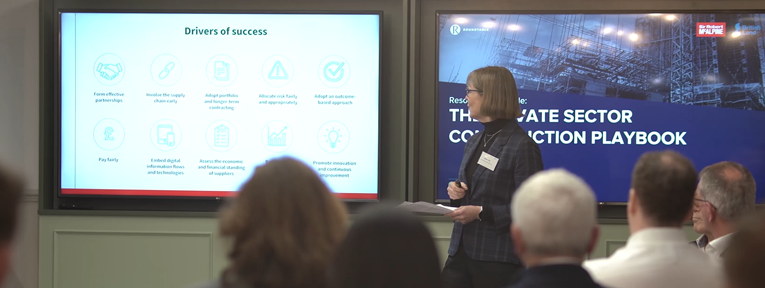
The discussion yesterday evening focused on the Private Sector Construction Playbook, a best practice guide published in November 2022. We were joined by two guest speakers, Alison Cox, Managing Director of Sir Robert McAlpine London Charles Horne, Project Director of British Land and, ResoLex Chief Executive Edward Moore.
Our Principal Consultant, Kelachi Amadi-Echendu began the session, by describing the journey from the government’s Construction Playbook to today’s Private Sector Playbook. She explained how the themes from the ResoLex publication ‘Changing Behaviours in Construction: A Complement to the Construction Playbook’, apply not only in the public sector but also to private sector projects and programmes, to enable improved delivery and better outcomes.
“Historically, the UK construction industry has been characterised by a lack of openness, poor productivity and a failure to invest in innovation”.
Foreword, Trust and Productivity The Private Sector Construction Playbook, November 2022
With many years of experience in the sector, driving excellence and delivering complex and challenging solutions for clients, we were delighted to have Alison Cox join us. Alison began explaining that the Private Sector Playbook was created by the construction productivity taskforce, a working group of developers, contractors, suppliers and professional service providers from the private sector whose underlying purpose is to try and improve productivity in the construction industry. She noted that whilst productivity had improved in a number of sectors, construction productivity had actually declined by 0.6% in the last 20 years. The document was designed to complement the Public Sector Construction Playbook that was released in 2020, taking cues from the public sector whilst understanding the challenges faced by the private sector.
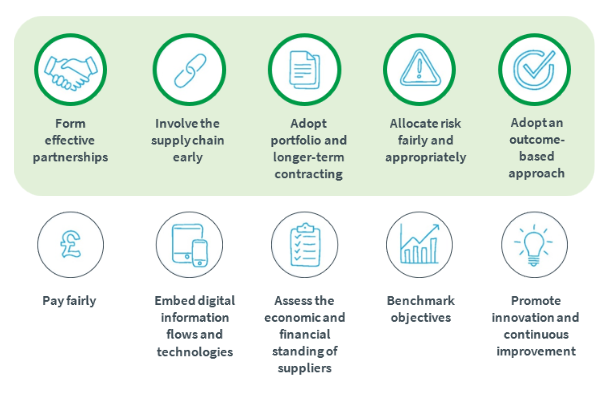
The Playbook is structured around ten key drivers for success, as illustrated in the diagram below. It is interesting to note that half of these focus on culture and behaviours. Alison emphasised the need to concentrate on building the right relationships, particularly at the beginning of a project. She mentioned her own experiences on the construction of the Bloomberg offices where key members of the different teams sat in close proximity in a co-located office. This was a project that was quite dynamic and required the team to be highly adaptable to changes in requirements. The strength of relationships established in the early phases of the project enabled the teams involved to focus on ‘best for project’ decisions, rather than solutions which might be best for individual organisations.
Charles observed the many changes in the construction industry since his experiences working on sites in the mid-1980s, as illustrated by the massive shift in safety that now exists compared to forty years ago. He highlighted the cultural change around health, safety and wellbeing, which simply did not feature when he first began his career. His primary observation is that projects are delivered by people rather than by technology or process. His recent experiences are drawn from Broadgate, where British Land is developing seven consecutive significant buildings under the Broadgate Framework. His starting point for creating the development strategy was the recognition that the customers for these properties are the local users in the area, and as such, care needs to be taken to avoid creating major disruption as the construction works to proceed. Charles’ approach required working with partners rather than suppliers, and so, in a significant break from traditional procurement practices, British Land has entered into a 10-year framework agreement with Sir Robert McAlpine. The framework enables British Land to reduce the risk of multiple concurrent projects and promotes consistency, continuity and innovation.
Contractual mechanisms aside, Charles, focused from the start on establishing an underlying ethos for the programme, based on the principles of Trust, Honesty and Collaboration. These principles have been developed into a set of rules, which every individual involved in the projects are expected to follow. The rules are generally self-policed, and there are very few instances where they are not applied by the numerous teams engaged in the programme. Charles identified a critical role that leadership plays in establishing a successful culture, recognising that in a collaborative contract, leaders need to be skilled at building ‘followership’.
He recognised the challenges of complexity and used the analogy of a pebble dropping into a pond and creating small waves. As projects grow in size and scale, leaders must deal with the challenge of lots of pebbles, dropping into the pool at the same time each creating ripples which intersect and disrupt with each other. He agreed with Alison that co-location is a critical factor in building cohesive and collaborative teams and is fundamental to building teamwork and understanding.
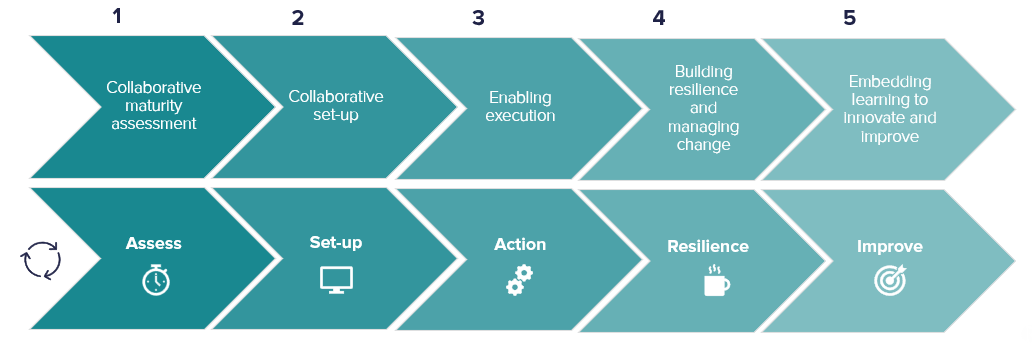
Ed Moore identified the need to establish the right culture from the start, quoting Abraham Lincoln, who said ‘give me six hours to chop down a tree and I would spend the first four sharpening the axe’. Ed made the case that programmes should treat relationship development as a distinct and separate workstream with its own targets and deliverables. Ed observed that too many project leaders tend to assume that their teams will naturally form into collaborative teams and therefore ignore the opportunity to shape the behaviours which occur at the very start. Ed also highlighted the need for project and programme teams to introduce a framework to help teams structure their workstream, and gave an example of the ASARI framework created by ResoLex as illustrated below:
Some of the key points of the discussion from the floor, were as follows:
- Project culture is directly linked to the quality of leadership.
- A critical skill for project leaders is to learn to listen to other points of view rather than press on with their sole perspective as to how a problem should be solved.
- The time for the individual heroic project director has passed. The role of the project director is now to build leadership throughout the team.
- The primary barrier to industry-wide adoption of the Private Sector Playbook remains a driver amongst many clients to appoint the lowest tender, thus propagating the bad habits, behaviours and relationships that inevitably emerge from such practices.
- The key to wider adoption must be to focus on being able to clearly articulate the difference between value over cost and use the successes of previous projects to persuade others to continue to support a route based on effective relationships.
As a final comment, Charles pointed out that on Broadgate, each of the individual projects is still negotiated within the framework. He nevertheless observed that not one contractual letter has yet been issued by either party throughout the delivery of the programme. As he put it, when a difficult issue arises it is ‘our’ problem, not just ‘your’ problem. This is a great illustration of collaboration working in practice.
You can find the featured publications linked below:
Nov 8, 2022 | Events
Rail Forum event – Infrastructure Collaboration: A Route to Success
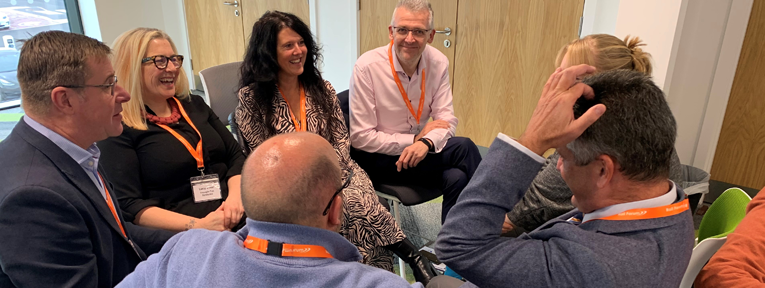
Last week, we had the opportunity to join the Rail Forum as an event partner and keynote speaker for their Infrastructure Collaboration: A Route to Success event. Around 80 delegates gathered together at the RaisE Business Centre in Goole to hear from industry experts to unpick collaboration, what it means for the supply chain and how it can work well in practice. Ben Higgens, Engagement Manager at the Rail Forum opened the floor explaining that in order for collaboration to work, it needs to be a win-win for all parties.
“Given how important collaboration is and will continue to be moving forward in the industry, we are keen that it does not become another buzzword. By providing an opportunity for our members to hear best practice case studies, key considerations for when looking to collaborate, and also a legal perspective, they are better placed to collaborate effectively”. – Ben Higgens, Engagement Manager at Rail Forum
Keynote: Creating a collaborative project environment to drive performance
ResoLex has been working for the last 20 years to embed collaborative environments in large infrastructure projects to achieve better project outcomes. We were therefore delighted to share our industry experience as the keynote speaker at the event. Our Chief Executive, Edward Moore started the session with a bang… well technically with a question! “Collaboration is the answer but what is the question?”
He pointed out that with just the 80 attendees there were 6320 potential connections in the room. If one thinks of some of the major projects with thousands of people in the supply chain, there are millions of potential connections! The greater the number of connections, the greater complexity involved in managing that project through to successful completion. Ed went on to look at the difference between transactional, cooperative and collaborative relationships and how to determine which approach is best for your project and whether collaboration is the right answer.
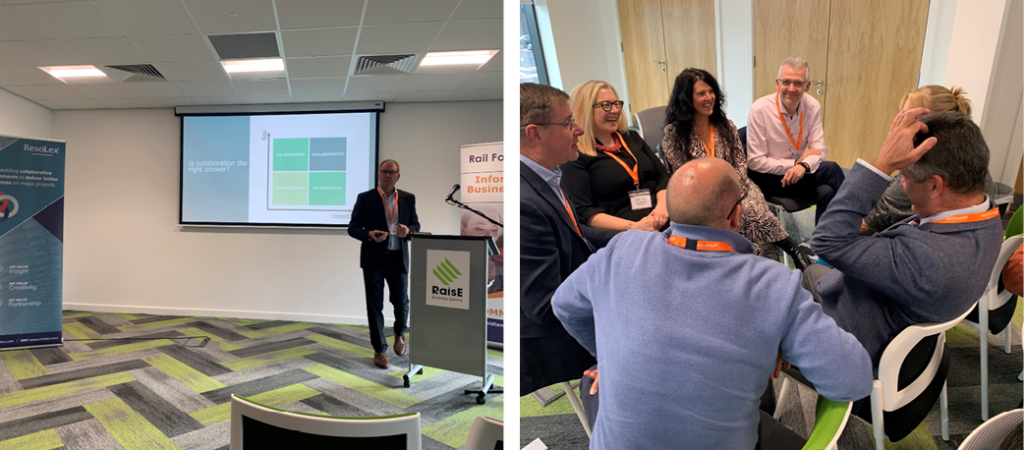
He then delved into what collaboration may bring including; enhanced benefits realisation, time-saving and an enhanced outcome, moving on to how one can create purposeful relationships and the attributes of a collaborative relationship.
“Let’s think about the most effective relationships we want and if the answer is collaborative then let’s not go in light-heartedly. Let’s do it with the right investment, and the right commitment and then what we can create is a connected ecosystem that allows the value to be drawn from all of the supply chain. The alignment, the sharing of knowledge between the client with their external drivers and their project objectives, right the way through so that everyone is part of an aligned supply chain that are all working to that one goal. Then I think we will start to see a real upshift in project performance and the value can be created.” – Edward Moore, CEO at ResoLex
Guest speaker summary
Speakers including Mark Smith from TAZIER, John Allsop from VAN ELLE, Jake Rudham from Unipart Rail and Graham Shaw from Volker Rail each explained the importance of collaborative relationships and environments on their projects. The key takeaways included the alignment of objectives within the partnership and understanding the scope of responsibilities. Drawing on the importance of business relationships, developing personal relationships with like-minded individuals within the businesses was also mentioned.
Mike Halliday, Network Rail Eastern expressed the need for behavioural change to understand the supply chain a little better. He also highlighted the importance of identifying risks early within a project and taking an approach that puts the project first. Many project leaders and professionals understand the need to identify risks but often miss or put less effort into identifying behavioural risks. ResoLex has developed a number of tools to use in complex environments to help identify these risks, you can find out more on our website here.
Emma Toes, Nelsons solicitors mentioned the considerations you should have and the legal boundaries in place for a successful collaborative relationship. She highlighted the need for a contract to protect your business, project and relationship.
To finish the session, Ben posed the question: What is one word to describe collaboration? With answers from the guest speakers including:
• Trust
• Alignment
• Reliability
• Pride
We’d like to thank those at the Rail Forum for their continued support and the opportunity to be a partner and keynote speaker at such an insightful event. We hope the importance of collaborative environments rings true for many working on major projects and in complex environments. If you think we could be of assistance to support your team, please get in touch.
Nov 7, 2022 | Events, Roundtables
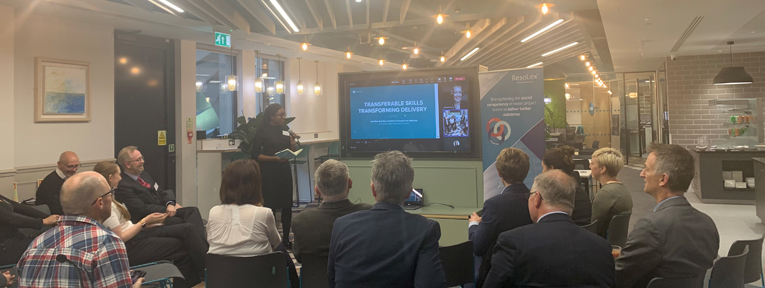
With guest speaker Rose McArthur, Director of Transport and Highways for Cheshire West and Chester Council and facilitated by Kelachi Amadi-Echendu, ResoLex
Kelachi opened the session with some background on ResoLex, explaining one of our underlying observations; projects rely on a triumvirate of competencies, technical, commercial and social. To set the landscape further, she highlighted a general challenge for lack of skills within the infrastructure sector. The skills problems begins at a high-level, so we have a technical challenge in areas such as climate change, as well as the economic challenges that organisations are wrestling with in a post-pandemic environment. The social component of major projects mentioned earlier encompasses these leadership challenges. The theme of the session was therefore to consider how we can bring people-oriented skills into the industry from other sectors whilst still appreciating the technical skills with career developments that aren’t necessarily leadership.
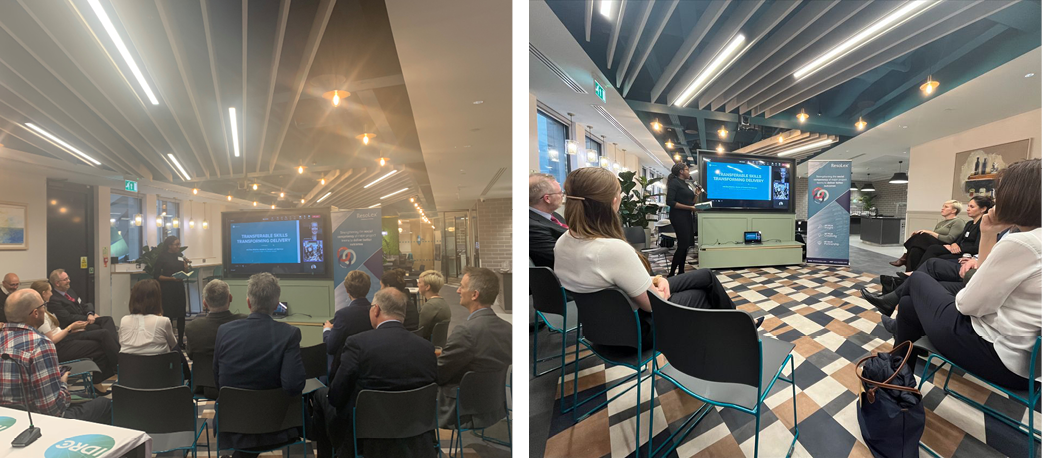
Rose started her presentation by talking about her own journey from being a Senior Consultant in a large engineering company, to a very different role in a local authority. Her background in integrated transport planning gave her the opportunity to work on huge projects such as the 2012 London Olympics, keeping people moving despite the challenge with an influx of people.
In her new role, she now has to focus on the practical problems within the highway sector exemplified by issues such as potholes, gulleys and pigeons. Many of the problems are much smaller in scale but there are huge amounts of them. Although Rose has a Director role and needs to strategically plan for the council’s transport and highways, many public enquiries are escalated to her due to a lack of communication from the project level and out to the local community.
Cheshire highways are a £5 billion asset, so there are many miles of road infrastructure that must be managed within very tight financial constraints. Rose made the point however that her biggest challenge is actually the people – as is the case in many engineering-focused teams, the historic basis for promotion is time served and technical expertise. Little concern has ever been paid to the skills of being customer focused and focusing strategically on future needs. All too often teams within the organisation have a silo mindset, and it is therefore difficult to get them to engage in new concepts outside of their core areas of expertise. So when it comes to management skills, technical competency is probably only around 25% of what is needed. Instead, there is a critical need for skills in communication, people management, delivering change, and the ability to engage a wider stakeholder group. Of course, some people with these technical skills may thrive in leadership and management roles but only with the right effort put into training – these important skills need development and training.
In developing her teams, Rose has found that she must therefore expand her search horizons when looking for new recruits. For example, she believes that change starts with the data-led approach, so the ability to analyse and communicate trends and issues is critical. She is also seeking people who have effective communication skills so that stakeholder relationships can be managed more effectively. More often than not, she has to go outside of the organisation to look for people in other sectors and industries to get the less technical but more strategic types of people to therefore reach the balanced team she requires.
Thoughts and observations from the floor included the following:
- An example was given of the huge value provided by somebody who had a passion for the environment but who originally came from a role in finance.
- Bringing in new skills and perspectives is important, but to be successful organisations need to be ready for the disruption they may cause. For example, construction firms are often not comfortable with people who are trying to push a different way of thinking.
- Leadership is critical in changing mindsets and behaviours. An example was given from a major programme where one of the senior leaders attended the sustainability group which significantly boosted attendance and output.
- There is a distinct leadership skill set around managing complexity and ambiguity.
- Creating resilient teams is one of the keys to survival in the 21st century, where leaders surround themselves with people who support each other in pursuit of a common goal.
The underlying message from the session is that in organisations that need to change, there needs to be a shift in the types of skills and competencies that may not be present in the current structure. The technical element which used to be dominant in many engineering-oriented businesses are still important, but at leadership, the level must often be subordinated to the ability to manage the problems created by complexity, scale and pressure on resources. The challenge for all organisations involved in infrastructure is to identify the different skills needed and create an environment which will encourage bright people to come and join them.

Oct 25, 2022 | Events
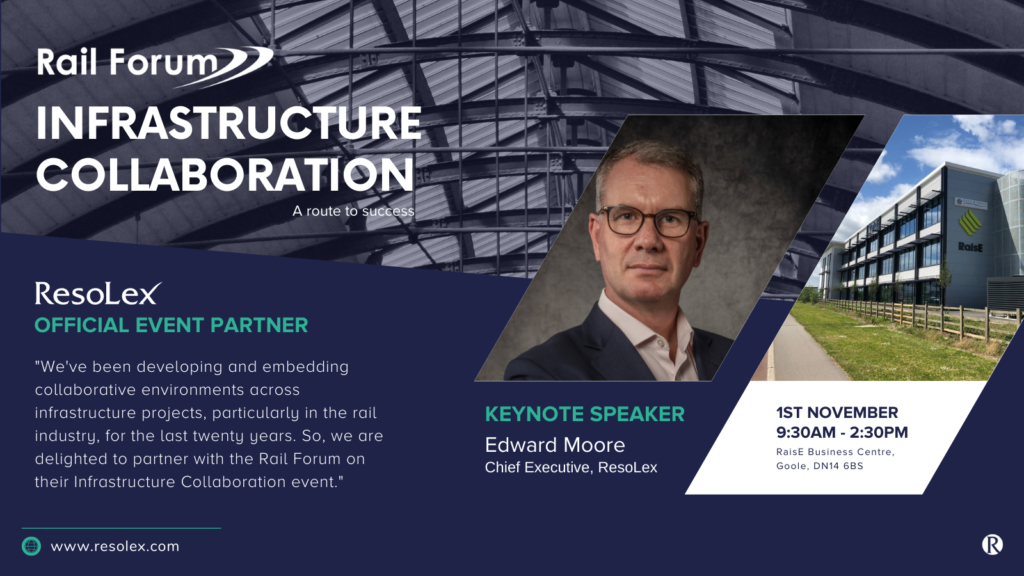
Event partner and Keynote speaker at the Rail Forum’s Infrastructure Collaboration event
Collaboration is a major buzzword in project delivery – and reasonably so, as more people recognise that it’s a key component of success. The challenge for many of us, is what does it look like in practice?
At ResoLex, we embed collaborative environments to deliver better outcomes on major projects. Our approach helps teams and project leaders manage the complexity of large-scale projects using a combination of behavioural theory, technology and industry experience to co-create new solutions to old problems.
The Rail Forum‘s ‘Infrastructure Collaboration – A Route to Success’ event aims to explore what collaboration means, and what it might look like in the rail infrastructure environment. With a topic so close to our hearts, we’re super excited to be an event partner and are delighted to share our experience and the industry insight we’ve built over the last 20 years with you all.
If you’re thinking of coming, we’d be delighted to see you! If you haven’t registered yet, you can use the link below:
https://www.railforum.uk/events/infrastructure-collaboration-a-route-to-success/
