
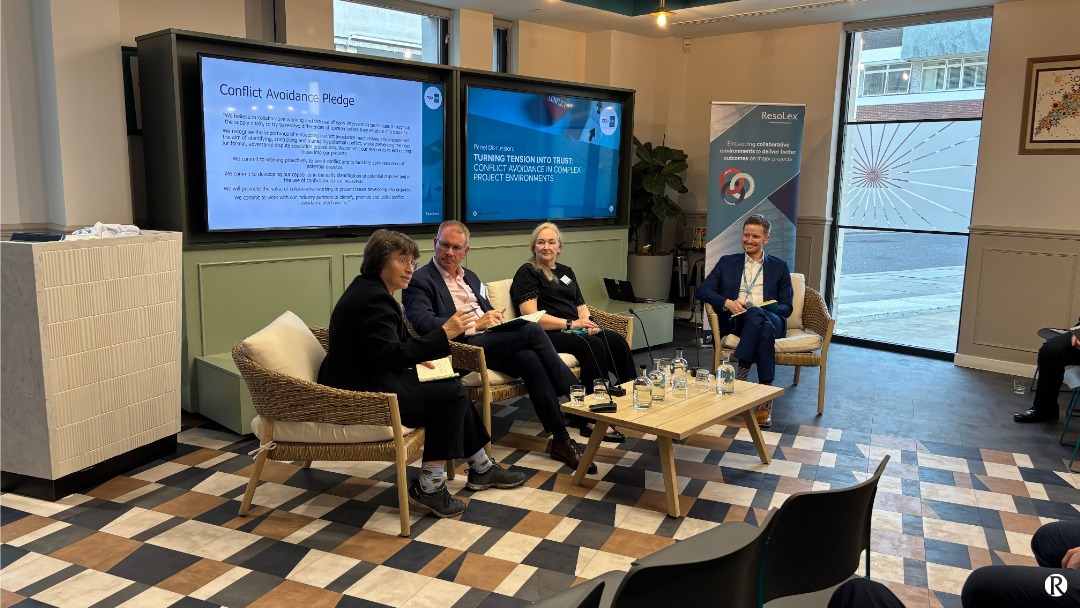
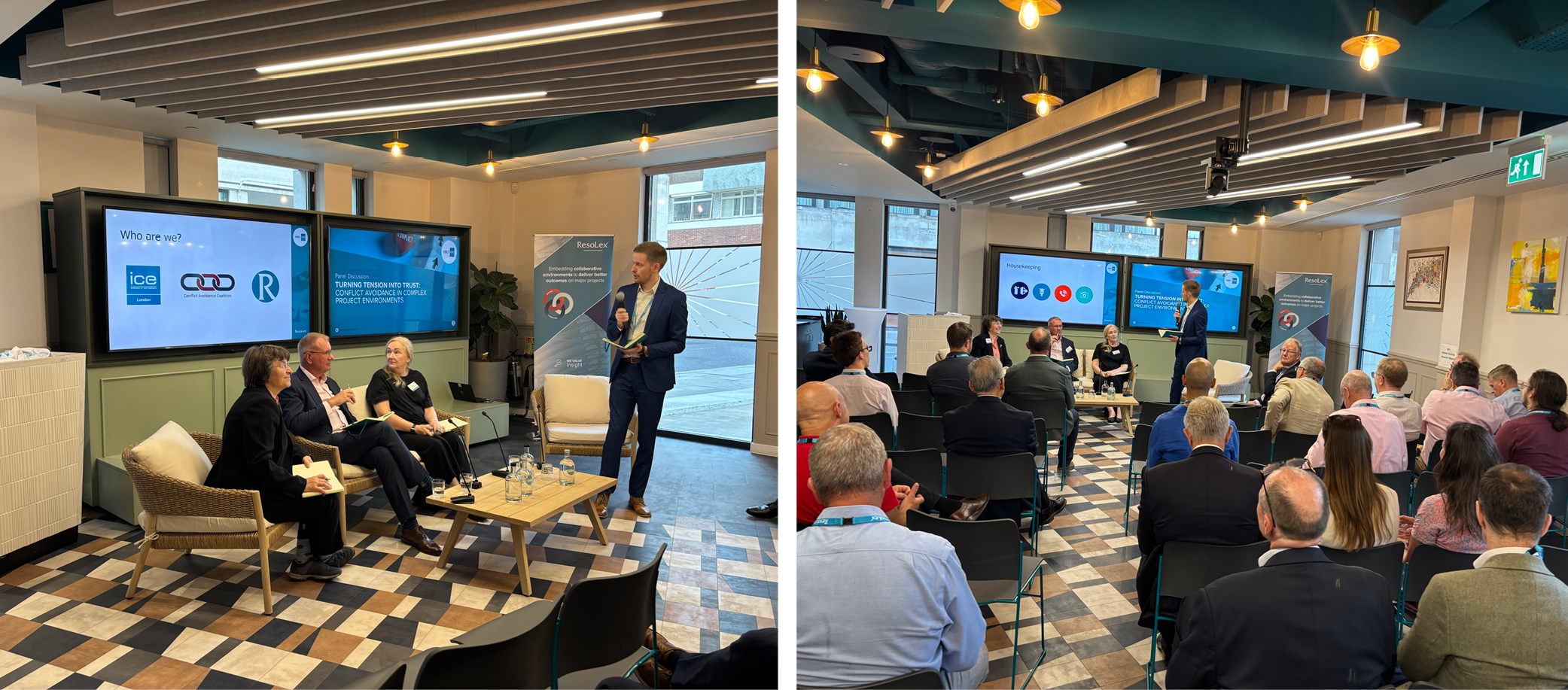
Conflict is inevitable on complex projects, but escalation is not. As major infrastructure programmes become increasingly complex, the industry’s ability to manage relationships is becoming just as important as its technical capability. Hosted by ResoLex in partnership with the Institution of Civil Engineers (ICE) and the Conflict Avoidance Coalition (CAC), Turning Tension into Trust brought together industry leaders Edward Moore, ResoLex, Sue Barrett, Houses of Parliament Restoration and Renewal Programme and Veronica Flint-Williams, Environment Agency to explore how projects can create the conditions for healthy challenge, identify behavioural risks early and create the conditions for productive challenge before issues become disputes.
The discussion reinforced a clear message: collaboration is not a soft option. It requires structure, openness, commercial discipline and the courage to have difficult conversations early. When done well, conflict avoidance can protect relationships, reduce cost and delay, and help teams remain focused on delivery rather than dispute.
Collaboration is not a soft option. It requires the most rigorous conversations.
Creating conditions for healthy challenge
One of the strongest themes throughout the discussion was the importance of creating a project environment that allows space for challenge and healthy tension from the outset. Tension is inevitable in project environments with so much complexity and uncertainty, but by establishing clear communication channels, defined escalation routes and psychologically safe environments from day one, organisations can harness it to drive challenge, innovation and better decisions. When those conditions are absent, issues are more likely to go unspoken, relationships come under strain and tension can quickly develop into destructive conflict.
To get healthy tension and challenge, it needs explicit permission.
Edward Moore illustrated this through the analogy of a farming community preparing for harvest. Crops are ready, cattle need moving, and success depends entirely on timing and communication. If everyone understands the plan, both objectives can be achieved. If communication breaks down, the crop is destroyed and everyone ends up firefighting. The comparison reflected the importance of establishing communication channels before pressure builds, rather than relying on them once problems have already emerged.
The client sets the tone
A strong theme throughout the event was that clients should be shaping the relationship from day one. Transparency about constraints, active listening when suppliers raise concerns, and the willingness to face problems early-on creates the conditions for trust.
The role of leaders was also highlighted, encouraging leaders to do more than simply permit challenge – they should actively model it by asking difficult questions, thanking people for raising concerns and demonstrating that constructive challenge is valued rather than merely tolerated.
Behavioural risks appear long before conflict
One of the panel’s key observations was that behavioural risks often emerge long before contractual disputes. Differences in perception, misunderstandings and unspoken concerns are often the first indicators that relationships are beginning to deteriorate.
The conversation reinforced that trusted relationships are built on rigorous honesty. Creating regular opportunities for open, honest feedback helps teams identify the early signs of conflict before issues become entrenched around commercial pressures, roles or ego. Practical mechanisms such as Conflict Avoidance Panels, project resets and tiered escalation processes provide structured opportunities to surface concerns, test assumptions and resolve differences before they become formal disputes.
What we end up seeing is the seed of conflict.
Prevention is an investment
The panel challenged the perception that conflict avoidance represents an unnecessary overhead or, worse, an admission that a project is expected to fail. Organisations can be reluctant to invest in prevention because they believe success is measured by never needing formal intervention in the first place. This creates a stigma around conflict avoidance, where investing in mechanisms to resolve issues early can be wrongly perceived as planning for failure, rather than planning for successful delivery.
Early intervention is almost always less costly than adjudication or litigation. More importantly, it keeps teams focused on delivery rather than becoming absorbed in dispute resolution.
Spending a little on a predictable outcome is a much better investment.
Key takeaways
- Plan communication and escalation routes before pressure builds.
- Invest early in prevention to protect delivery focus, reduce cost and avoid the distraction of formal disputes.
- Give challenge explicit permission and model it through leadership behaviour.
- Clients set the tone by being transparent about constraints and listening when suppliers raise difficult issues.
- Behavioural risk often first appears as a divergence in perceptions, making safe feedback loops essential.
- Treat conflict avoidance mechanisms as good project governance, not evidence of failure.
- Use resets, panels and tiered processes before issues become formal disputes.
The audience discussion reinforced the practical challenges of applying these principles in live projects. Topics ranged from managing uncertainty transparently and responding to change, to creating collaborative cultures where clients are still on their own maturity journey, and giving people the confidence to have difficult conversations early.
While every project is different, the panel agreed that trust is built through openness, clear expectations and the confidence to address difficult conversations early.
The evening concluded with a challenge from Richard Bayfield, Chair of the Conflict Avoidance Coalition: “What’s the one thing you’d encourage people to do differently tomorrow morning to turn tension into trust?”
While the answers varied, one message stood out: contracts provide the framework, but people determine the outcome. Trust is built through early conversations, disciplined collaboration and leaders who create the confidence for others to challenge constructively.
Tension will always exist on complex projects. The opportunity lies in creating environments where it leads to better decisions rather than destructive conflict. By addressing issues early and fostering collaboration, organisations can strengthen relationships, improve delivery and build greater confidence in the infrastructure sector.