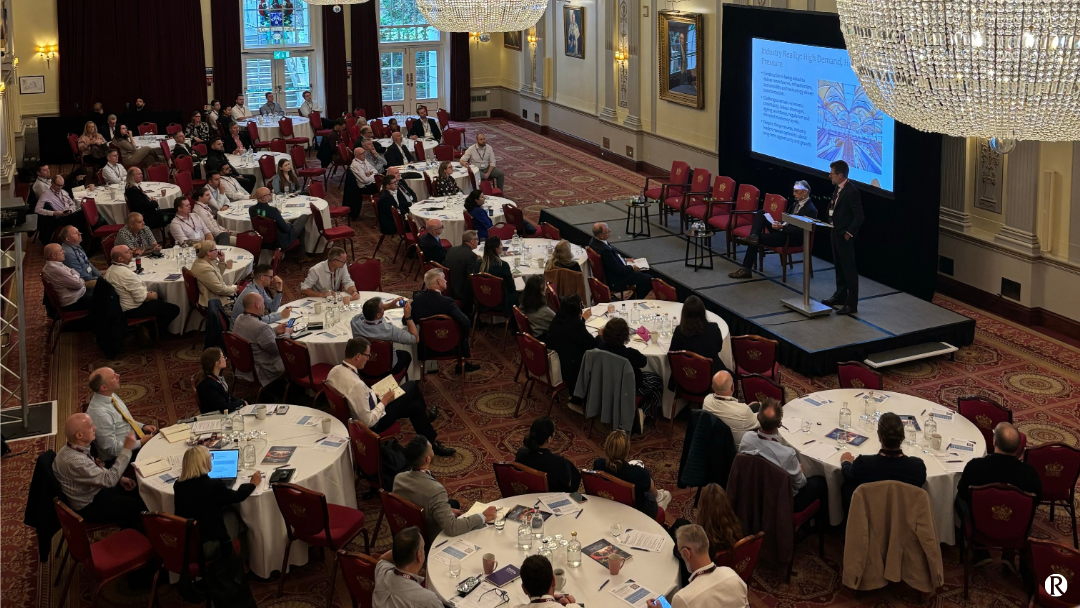
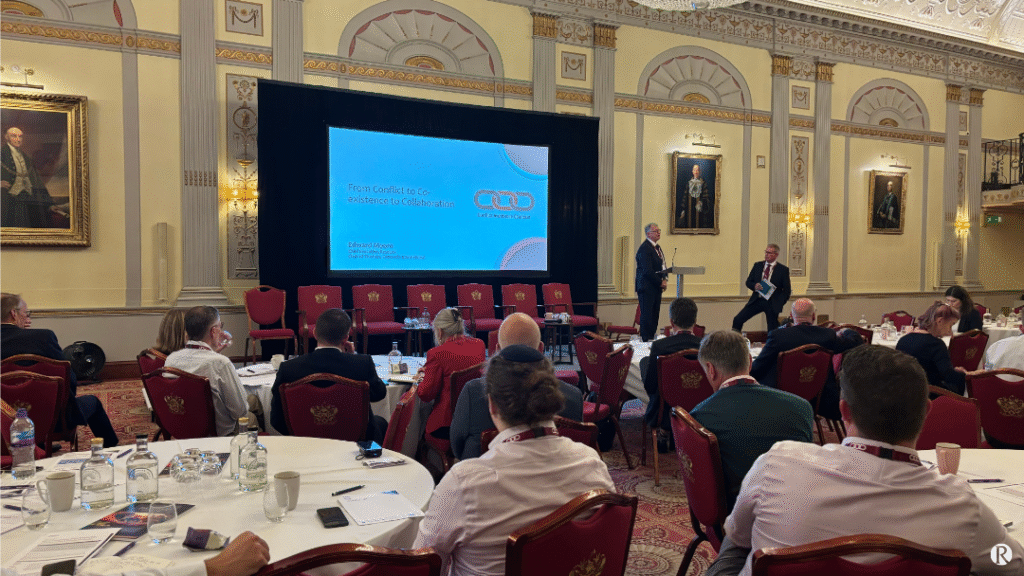
At this year’s Conflict Avoidance Coalition Conference, which ResoLex was pleased to support as a sponsor, our Chief Executive, Edward Moore, spoke about the journey from conflict to coexistence to collaboration. ResoLex has supported the work of the Coalition for many years, sharing its commitment to helping the industry address conflict earlier and create better conditions for projects and programmes to succeed.
Drawing on his experience through ResoLex, as Chairman of Concordis International and as a Fellow of the Institute for Collaborative Working, Ed brought together perspectives from complex project delivery and international peacebuilding.
Running throughout his session was one question: is a lack of conflict enough?
For major projects and programmes, avoiding disputes is clearly important. But does the absence of conflict mean that a project is working well? And is there enough drive across our industry to make the behavioural changes needed to move beyond simply avoiding problems and towards better performance?
These are questions we have been grappling with at ResoLex for a long time.
Starting with resolution
ResoLex started life firmly in the world of dispute resolution and contracted mediation. Even our name reflects those origins: ‘Reso’ from resolution and ‘Lex’, the Latin for law – resolution before the law.
During his talk, Ed shared two examples from those early days where ResoLex was brought in to help project teams work through some significant issues. Both projects overcame those challenges, finished on budget with no outstanding claims at completion.
You might expect those results to have made the case for taking the same approach elsewhere. In reality, it was difficult.
Ed described some of what we encountered at the time as a combination of naivety, optimism bias and threat. Naivety around the behavioural risks that can develop within projects; optimism bias that, while problems might happen elsewhere, they won’t happen to us; and a sense of threat that acknowledging the need for support could somehow suggest that a team wasn’t performing well enough.
Despite the success of those early projects, preventative services were difficult to sell.
A lot has changed since then. There is now far greater recognition of the role that behaviours, relationships and culture play in project performance. But the underlying question remains relevant.
If we successfully avoid conflict, what comes next?
Ed explored this as a spectrum: conflict → coexistence → collaboration.
To bring that distinction to life, he shared an example from the work of Concordis International in Abyei, the Special Administrative Area between Sudan and South Sudan.
Seasonal cattle movements in the region had become a source of serious conflict. As cattle moved in search of grazing, tensions with farming communities could escalate, contributing to the loss of hundreds of lives and requiring armed protection.
Moving from conflict to coexistence could mean finding another route. Keep the cattle and farming communities apart and remove the immediate source of tension.
But collaboration asks a different question: could that interaction actually benefit both sides?
With the support of peace committees and trained mediators, the communities were able to reach a benefits-based arrangement. Rather than avoiding the farmland, cattle moved across it, eating the remaining grass and trampling and fertilising the ground in the process.
The arrangement continued for more than two years, turning something that had been a source of conflict into something from which both communities could benefit.
It is a very different environment from a major project or programme, but there is an important principle we can take from it.
Stopping conflict and creating collaboration are not the same thing.
We should collaborate. But how?
Collaboration is now part of the language of major projects. We hear regularly that teams need to collaborate more, work in partnership and break down silos.
But simply deciding to collaborate doesn’t make it happen.
Collaboration can sometimes be treated as a benefit or an outcome in its own right. What matters more is what collaborative delivery allows us to achieve. When it works, it should help create better outcomes for the programme and tangible benefits for the different organisations involved.
To get there, we need to understand the drivers, objectives and value points of the different parties around the table.
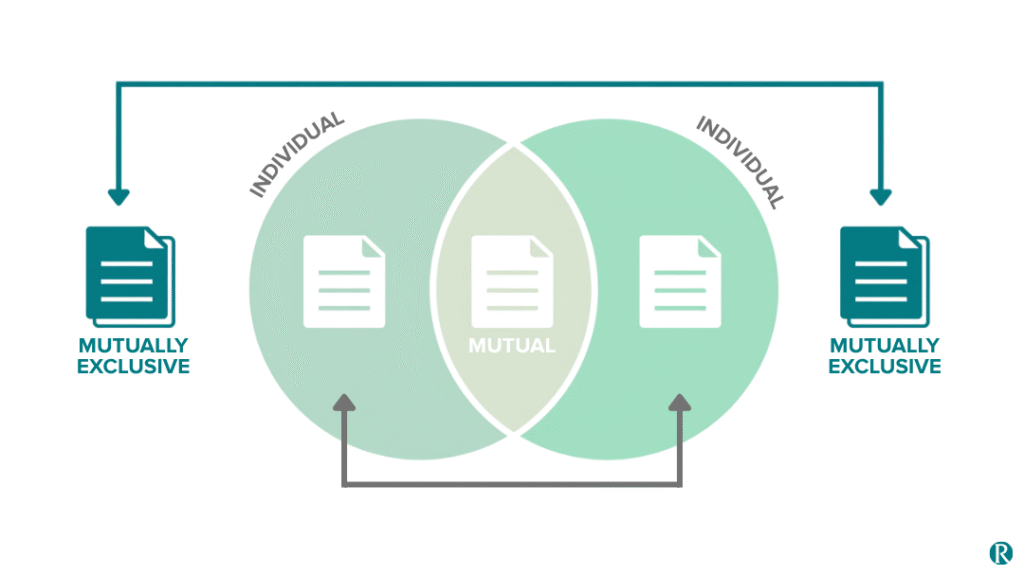
Finding mutual objectives is important, but it doesn’t give us the whole picture. Every organisation involved in a major programme also has individual objectives, pressures and priorities. Those don’t disappear simply because everyone has agreed a set of shared goals.
The opportunity is to make those individual objectives better understood.
When parties understand what others need to achieve, they can begin to see where their own actions can help others succeed, as well as where their objectives overlap. That creates the potential to move beyond simply having mutual objectives towards identifying outcomes where collaboration creates genuine benefit across the programme.
Communication has to be purposeful
This brings us back to some of the practical work required to make collaboration happen: interface management, communication and developing trust.
Better communication isn’t simply about reducing the likelihood of misunderstanding or conflict. Done properly, it can improve performance.
But it needs to be designed.
Who needs to speak to whom? What information needs to move between different teams and organisations? When does that communication need to happen? How often? Through which forum? And, importantly, what does each party need from the interaction?
These sound like straightforward questions, but on a major programme involving multiple organisations, interfaces and competing priorities, leaving them to chance creates risk.
Taking a purposeful approach means understanding the drivers and objectives of those involved, identifying where benefits can be created across organisational boundaries, and then putting the collaborative delivery methods and communication routes in place to support them.
Conflict avoidance matters. But perhaps the bigger opportunity for our industry is not simply to ask how do we stop conflict?
It is to ask what sits beyond it?
Moving from conflict to coexistence and ultimately to collaboration gives us the opportunity not only to avoid disputes, but to use our relationships, behaviours and communication to drive better performance across major projects and programmes.