
Jul 18, 2025 | News and insight, Social value
My work experience placement at ResoLex showed itself to be a valuable and fun insight into the professional world. I thoroughly enjoyed the unique experience of meeting different employees in both one-on-one scenarios and group discussions. The structure of the day allowed for six different meetings where I had the opportunity to discuss their roles, responsibilities and career trajectories. I also had the chance to discuss my future with employees, including Jay, who studied business management, which I’m also planning to study after my A levels.
I loved coming to London and getting an understanding/ experience of business culture, which I feel was especially prominent in a small company like ResoLex. Not only do I feel more educated and confident in a business environment, but I also now look forward to working in one. I was given a busy, structured schedule full of a range of different meetings, both online and in person, including a group meeting where I was encouraged to share ideas and got to witness how professional meetings are conducted. Everyone that I had the pleasure of speaking to seemed to take a high interest in my time and reason for being there, which hugely contributed to why I enjoyed and learnt so much from my day here.
Overall, I deeply appreciate the time and effort put towards my day. It’s rare that students are given opportunities outside of simple tasks or shadowing others during work experience, with many spending their time not engaging in any actual activity. However, I was kept busy the entire day thanks to the team at Resolex and have genuinely gained so much from it.
Thank you, everyone.
Freddie Le Roux

Jul 16, 2025 | News and insight
Only 8.5% of mega projects deliver on time and budget*.
This was the opening line at the ICE event ‘Lessons from the Tideway Project’, and it’s certainly one that catches your attention!
Mainly because Thames Tideway, the £4.5bn, 25km super sewer under London, has managed to be one of those few ‘unicorns’ – despite the challenges of a major urban area, challenging stakeholders, and even being hit by a global pandemic.
So, how was this such a success? And, what can we learn to create the same environment for success?
The event began with a keynote speech from Andy Mitchell CBE, the CEO of Tideway, followed by a panel discussion with Chris Merridew, Roger Bailey, Wendy Gillies, and Rafael Foulquie, facilitated by Raj Pathak, that represented some of the key organisations within the Tideway Alliance. Andy’s speech highlighted four key themes to Tideway’s success, which were supported and reinforced by the panellists:
- Culture: Tideway built its culture from the ground up, with appropriate ground rules for ways of working that focused on the vision. Important to note that the culture always had to drive decisions and behaviours, rather than being secondary to ‘profit’ or the ‘mission’. As Andy put it: Culture that only works on good days is an inauthentic illusion! The project culture was fundamental to enabling the other themes, as well as the wider success of the project.
- Financing and contracting: Tideway had a practical approach to financing and contracting, with a sensible range of outcomes that would define success and straightforward supply chain contracts – and, importantly, a straightforward approach to using the contract in practice: It’s all well and good saying “the contract says that’s your problem”, but if it’s a big problem, you can’t hide your head in the sand! This requires practical, forward-thinking decision-making, built on trust.
- Effective leadership: Tideway set up an effective, independent board that enabled rapid decision-making so that they could get on with implementing those decisions!
- Clear relationships: Tideway focused on building good relationships with informed stakeholders, having regular meetings, with transparent information sharing to ensure that the key stakeholders, both internal and external, knew what they needed to know to do their jobs, and build the trust needed to effectively deliver together.
Andy was clear that embedding these themes was not an overnight job – it took years to build and define what success looked like and build the trust needed to deliver!
In the panel discussion, all the participants repeatedly echoed the vision: Reconnect Londoners with their river. This was clearly more than just a corporate platitude, but something that every person, regardless of their position or parent organisation, believed in.
So what were their big tips for ensuring success?
- Build trust with your internal stakeholders, those on the ground delivering your vision – through transparency, clarity, and doing what you say you will.
- Build an aligned and inspiring vision – make sure everyone knows why they are there and what they are working to!
- Embed behavioural safety – so your people dare to be the best they can be, knowing they are supported
- Introduce play – let people be imaginative, try new things, and transform the way we deliver.
- Finally, it all comes back to the Client – be clear on what you stand for, because ultimately the culture and behaviours that underpin project success start from you. Whether it’s an Alliance arrangement or a classic transactional environment, you are the leader, and you demonstrate the way things should be done.
Ultimately, it was inspiring to see a project that understood the need for and focused on the people, ways of working and the project culture – and got the right results from doing so!
* based on the research by Bent Flyvbjerg

May 30, 2025 | 25 in 25, News and insight
As we celebrate 25 incredible years of ResoLex, we’re shining a spotlight on some of people who make it all possible — our Associates.
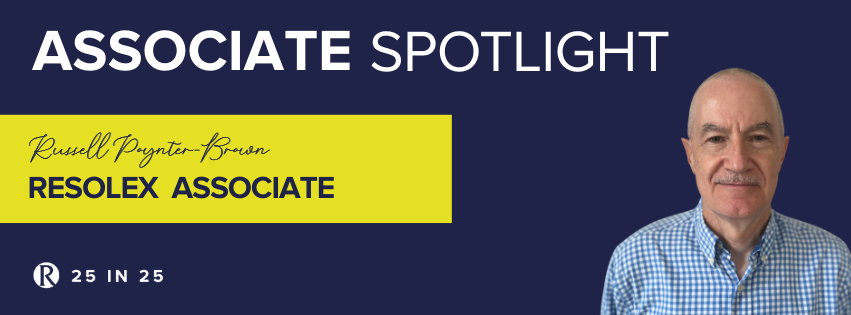
We asked a few of them to share why they choose to be part of the ResoLex team, and their reflections have been nothing short of inspiring. Here’s what Russell Poynter-Brown had to say:
“I was delighted when Ed and Tony asked if I’d come and work with them on a high-profile, complex and multi-stakeholder programme, especially as a key workstream centres on collaborative working.
In all honesty, I’d almost given up on the construction and infrastructure sectors, as it is so rare to find clients, consultants and other advisers who fundamentally understand what it takes to work in a truly collaborative environment.
ResoLex is refreshingly different. It uses its 25 years of expertise and insights to constructively challenge clients and then work with them to think laterally, suspend judgement, and then co-create programme-specific practicable, long-term value-added solutions, with measurable programmatic benefits.
The ResoLex team is a constant source of creative ideas and solutions. I‘ve never felt freer to work in a psychologically safe environment, where I can test my thoughts or ask for comments and opinions without feeling that I’m being judged or fearing that the Team already has a ‘stock’ answer that I’d be forced to adopt.
Highly complex programmes invariably have their challenges which can often adversely affect working relationships. However, ResoLex has a fundamental understanding of how people work in teams, in particular the interaction between people, processes and the environment within which team personnel work. I’ve been fortunate to be able to tap into this knowledge bank and adapt several ‘in-house ‘ models for our programme client’s benefit, enhancing its ability to work in a more collaborative way.”
Stay tuned on LinkedIn throughout our birthday celebrations as we continue to showcase some of the voices behind ResoLex — the people driving impact and making a real difference every day.

May 8, 2025 | 25 in 25
In 2000, we embarked on a pioneering project with the State of Jersey on the construction of their £15m Alpha Taxiway at Jersey Airport. This initiative marked the first commercial use of a dispute resolution service known as Contracted Mediation – a proactive approach designed to operationalise dispute escalation protocols and enable the swift resolution of issues before they escalated into entrenched disputes.
Midway through the project, a significant disruption occurred in the finish of the taxiway. Under normal circumstances, this could have triggered a prolonged and costly dispute between the airport and the main contractor. However, thanks to the pre-agreed Contracted Mediation process, a panel of independent mediators from ResoLex were rapidly deployed. Over the course of a two-day partnering workshop, they facilitated a deep dive into the problem, working with both parties to seek a constructive path forward.
Crucially, the ResoLex panel approached the issue from a needs-based perspective rather than a rights-based one. Rather than focusing solely on contractual entitlements, they explored what each party needed in order to move forward productively. By mapping out several possible scenarios and outcomes, the panel helped the team realise that continuing a dispute would only divert valuable time and resources. Instead, both parties agreed to prioritise resolution and recommit to the successful delivery of the project.
Following the intervention, both the client and contractor reported that the process had been transformational. They described a sense of relief, a renewed focus on shared goals, and a shift in project culture – resulting in what we would now term a ‘collaborative relationship’. The project team realigned around the question: What does each party need to be successful, and how can we support that?
As a result, the Alpha Taxiway project was completed on time and under budget, despite the challenges encountered mid-project.
Key Takeaway
This experience demonstrated that performance improvement through collaboration requires more than good intentions – it depends on creating a project culture that values needs as well as rights. Contracted Mediation proved to be an effective tool in fostering that culture, turning a potentially confrontational situation into a collaborative success story.
We were gobsmacked and amazed at how quickly and simply ResoLex helped us all reach a satisfactory agreement. – Client representative

Mar 18, 2025 | News and insight
Projects, by their nature, are technical and commercial enterprises. However, what often makes or breaks a project is not a technical issue or even a commercial or cost one – but whether the relationships built can support and drive delivery.
It is easy to overlook the importance of these relationships as projects are driven to deliver quick wins or short-term gains such as “getting a shovel in the ground”. But focusing on these immediate wants risks undermining the long-term needs for our success, including the trust and collaboration that keeps things moving forward, particularly in modern mega- or even giga-projects where delivery is no longer a simple client/contractor relationship but a web of interconnected delivery partners and organisations.
Relationships between these organisations are what drive your delivery – but they are often not considered or worked upon in any meaningful way. At best, we might begin to think about interpersonal relationships, but what about interorganisational? After all, each component partner likely has their own ways of working, their own values, and their own ideas of what success looks like
We see the evidence of this lack of consideration everywhere. How many times have you encountered an organisation – client or otherwise – that is always in a ‘state of emergency’? Where every ask has to be answered right now? Perhaps a few times their partners will go along with it (if they have a good relationship), but sooner or later someone will say “no” – and then where does that leave the asker?
Even within a traditional client/contractor relationship, the client may be constantly demanding that their contractor push costs down, or deliver faster, or deliver more, focusing on the client’s immediate ‘wants’ – but if this results in the contractor failing, both sides lose – the client has a failed project, and the contractor may be facing dire consequences, including insolvency.
Further, in complex modern project environments organisations will often be interacting outside of this transactional “I tell, you do” relationship, and so cannot even fall back on the (as mentioned, potentially unsustainable) “well the contract says you have to”.
So, if relationships are that important to project success, what can we do about them?
For interpersonal relationships, Schein & Schein set out a model with four ‘levels’:
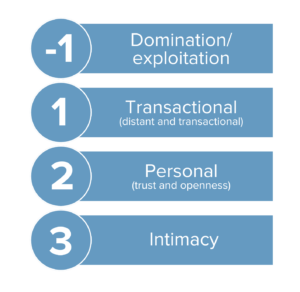
Can we also apply these to the relationships between organisations? And what would that look like?
- Level -1 would consist of an exploitative relationship where one organisation is totally dominant of another, free to use and abuse them without accountability
- At Level 1, we would have the traditional transactional relationship – client/contractor, where one party holds all the power, and will only ever be thinking about their own needs – or more likely, their own wants, at any given time.
- Level 2 places parties in a position of openness – which enables a deeper understanding of other parties’ needs, as well as your own. Because only through understanding the needs of those you are relying upon to deliver, can you fully understand what yours are, and begin to evaluate your wants in terms of those needs.
- Level 3 would represent a level of intimacy between organisations which is likely unnecessary to most delivery environments. It may have a place in certain places where an acutely high level of trust and dependence is required, but otherwise, it applies far more to our personal relationships than our professional ones. It may even be detrimental, where clients favour one organisation to the exclusion of others, or two partners are co-dependent for any decision-making!
As with interpersonal relationships, Level 2 is the ‘sweet spot’ for delivery. Both parties recognize that achieving long-term goals means building mutual trust and aligning on shared objectives. Instead of viewing interactions merely as exchanges of services for payments, Level 2 encourages us to see our partners as collaborators whose success is intertwined with our own. This shift from a wants-based approach – built upon a system of ‘knowing your rights’, where contracts and legal obligations dominate – to a needs-based mindset opens the door for genuine problem-solving.
And, if those technical or commercial issues do raise their heads – you can proactively resolve or mediate them rather than resorting to costly disputes, where ultimately nobody’s needs will be met!
Tom Chick is a senior consultant at ResoLex specialising in building effective working environments in major projects. If you want to learn more about how to get the most out of your professional relationships, contact Tom here or connect with him on LinkedIn.
